Wrestling is at its best when it’s looking at the future.
While nostalgia can provide short-term success, it’s not a sustainable strategy. WCW had a boom from 1996 to 1998 with stars of yesteryear like Hulk Hogan as the centrepiece of their programming, but their stubbornness to create new stars led to their downfall.
In the 2000s, WWE’s reluctance to give a main event push to anyone not named John Cena or who had not been with the company since the Attitude Era led to a stale product, which turned away fans from the company.
The same could be said about TNA hesitating to give sustained main event runs to Samoa Joe and AJ Styles while Jeff Jarrett monopolised the title and feuded with ex-WWE and WCW talents like Kurt Angle and Sting.
AEW is at a similar place, where its main players were established as stars elsewhere. Chris Jericho, the first AEW World Champion, was a mainstay in WWE. Jon Moxley, despite a lacklustre creative in WWE, was already a multi-time world champion. Kenny Omega was a star in NJPW.
It was clear when the company launched that it would build around those three. Having these established stars would help newcomers like”Hangman” Adam Page, Jack Perry, Darby Allin, MJF, etc.
However, those prospects are far from where they were expected to be.
MJF has become a one-trick pony stuck in the midcard scene. His over-reliance on shock value has desensitised fans to the point where people expect him to bring real-life issues into storylines and forget them immediately after.
Darby Allin had what should have been an important victory against Jon Moxley at WrestleDream, but his momentum didn’t pick up. He was put into a program with Pac, whom he lost against at Full Gear.
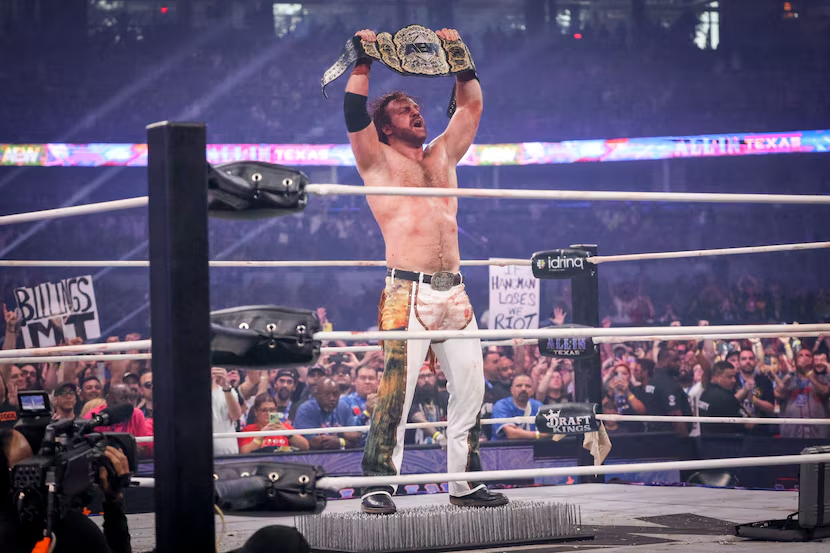
“Hangman” Adam Page, whom the Young Bucks called the company’s main character, has been crowned champion twice and lost his belt both times against ROH alumni, CM Punk and Samoa Joe. It didn’t help that he didn’t feel like the company’s face during both reigns; the main event spots were still filled with the likes of Moxley, Omega and the Young Bucks.
Swerve Strickland, who felt like a star during his world title reign, feuding with contemporary stars like Will Ospreay, lost his belt to Bryan Danielson at All In, who would retire two months later.
AEW failed to keep the momentum of the two stars they created, sacrificing them to indie darlings of the aughties who are past their prime and should be giving the torch to the future of the industry.
While WWE’s current creative direction is frustratingly safe with a main event scene overcrowded with guys who debuted with the company two decades ago, it is safe to assume they will pull the trigger on Jacob Fatu and Bron Breakker when the time is right, although we feel like this time cannot come too soon.
AEW has a different problem where they haven’t proven their ability to create stars. Their big players are scattered throughout all their divisions, with Konosuke Takesitha, Kazuchika Okada, Kyle Fletcher or Bobby Lashley seemingly not interested in a shot for the world title.
The company’s young prospects should be flag bearers for the company right now, and AEW might as well learn to push them there before the current main eventers retire and they are forced to.